Defending Democracy
Czech Republic and Slovakia
Exposing Gendered Disinformation

This publication examines how gendered disinformation has become a systemic barrier to women’s equal participation in democratic politics in Czechia and Slovakia.
Drawing on triangulated research methods, the study combines:
- Quantitative monitoring of social media using Gerulata Juno (a technological platform) to track disinformation narratives,
- A survey of women politicians at national, European, and local levels, and
- In-depth interviews providing first-hand accounts of online and offline abuse.
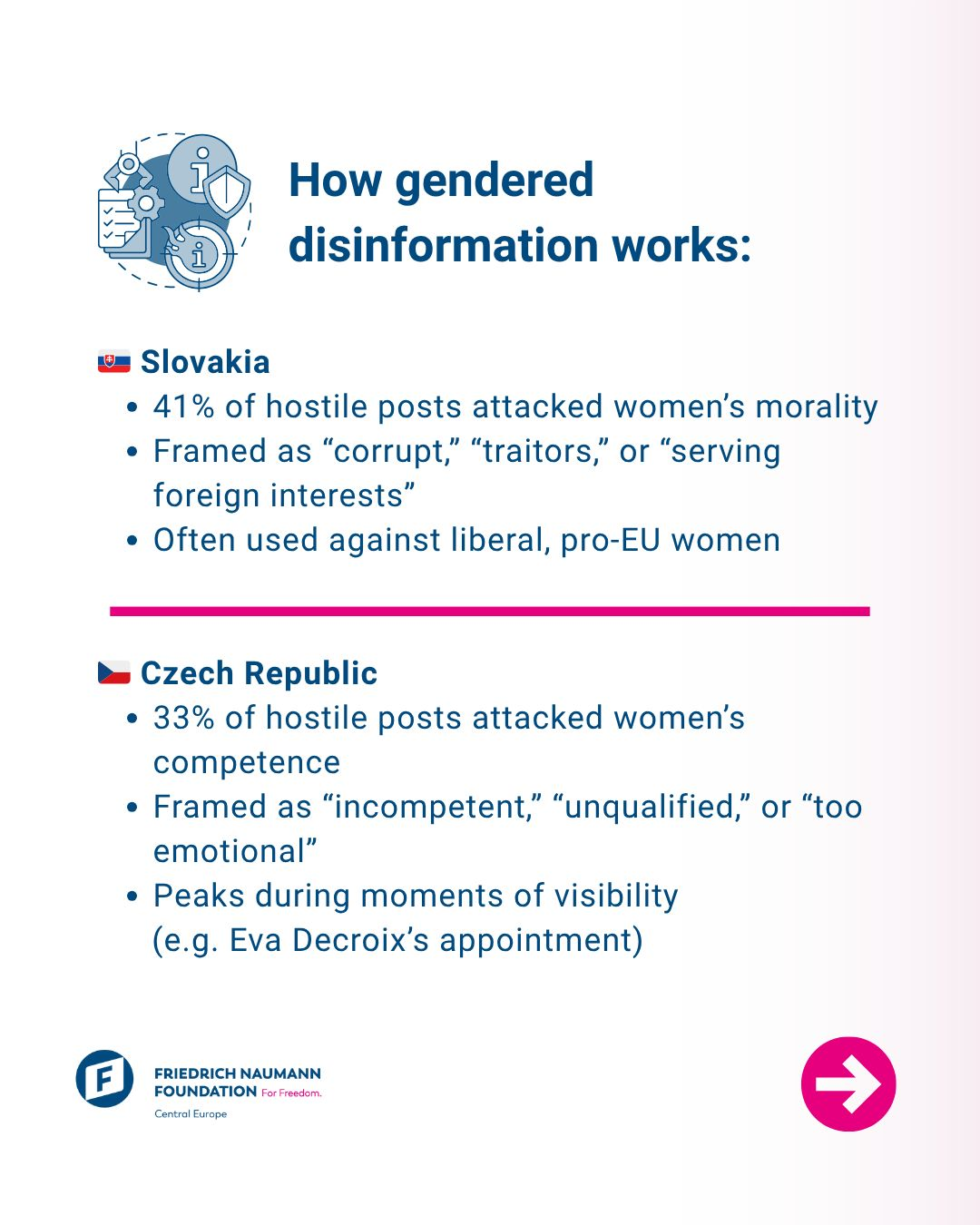
The research reveals how gendered disinformation weaponizes gender stereotypes and personal attacks to discredit women, question their legitimacy, and silence them. In Czechia, narratives often depict women as incompetent or unqualified, while in Slovakia, they are more frequently portrayed as morally corrupt or betraying national interests. Alarmingly, such narratives are not confined to extremist circles; they are often amplified by mainstream political figures and media actors.
This publication also highlights resilience and agency. Despite persistent attacks, women politicians continue to serve, relying on solidarity networks, personal coping strategies, and civil society support. However, the report stresses that individual resilience is insufficient without systemic reforms by institutions, political parties, and digital platforms.
Key Findings
- Gendered disinformation erodes democratic competition and civic trust by deterring women from public life.
- It causes secondary trauma for families and deepens polarization and misogyny.
- It demonstrates that digital disinformation is intertwined with offline power structures and institutional neglect.
The publication offers several recommendations that call for coordinated action to:
- Recognize gendered disinformation as part of broader hybrid threats to democracy,
- Strengthen protection and support mechanisms for women in politics,
- Hold digital platforms accountable, and
- Promote inclusive, pluralistic political discourse.
By framing gendered disinformation as a democratic and human rights issue, not only a gender issue, the paper advances public understanding and inspire policy responses that uphold equal participation and freedom of expression in Central Europe.

Ein Angebot der

Informationen
Service
Weitere Angebote
Toleranz für Diversität